Bidspirit | автомобильный аукцион Especially Rare Variant: Ohr LaShamayim | 27/8/2023 Winner'S
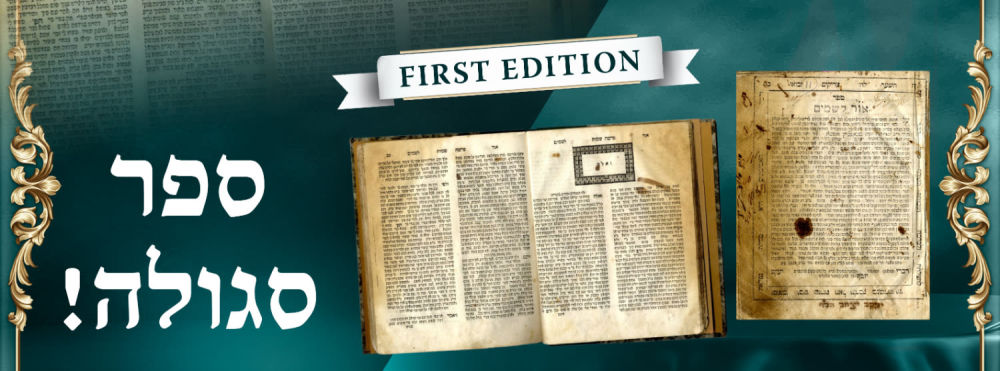
Especially Rare Variant: Ohr LaShamayim by Rabbi Meir of Apta - Lvov, 1851 - First Edition. Segulah Sefer. Signature of the Rebbe of Stavnitz? - ”Master of the world, know that I am alone in your hands as clay in the hands of the potter ...” It is a segulah for livelihood to recite this on a daily basis (The Tiferet Shlomo of Radomsk) Ohr LaShamayim the Chassidic work by the renowned Admo”r Rabbi Meir'l of Apta, leading disciple of the Chozeh of Lublin, known by the name of this sefer , as the author of Ohr LaShamayim . (Lemberg, Franz Galinsky Press, 1851. Including an approbation by his disciple, the author of Divrei Chayim ) of Sanz, printed at the end of the sefer . Especially rare variant with the printing details at the end of the sefer . First edition of one of the most important and well-known sifrei Chassidut . The sefer includes Chassidic ma'amarim on Chamishah Chumshei Torah as well as likkutim and segulahs (mainly segulahs for livelihood, see for example parashat Balak Torah 44, on the days of Bein HaMetzarim : ”These days are a segulah for livelihood ... and it will pour out from this golden pipe; the pool of sustenance is there ...”) ”Rabbi Meir HaLevi, av beit din of Stavnitz and Apta darshened this from there, as he received from his rabbi, Rabbi Ya'akov Yitzchak HaLevi [the Chozeh of Lublin].” This sefer is the source of the well-known prayer ”Master of the world, I know that I am alone in your hands as clay in the hands of the potter ...” - known as a segulah for livelihood. At the beginning of the sefer , after the introduction, there are several important prayers composed by the author of Ohr LaShamayim . The most famous of them is the one that begins with the words, ”Master of the world, know that I am alone in your hands as clay in the hands of the potter. And even if I use counsel and tricks and all the inhabitants of the world will stand at my side to save me and support my soul, if not for your might and your help, there is no help and no salvation.” This renowned prayer, sung by one and all, was composed by the Rebbe Rabbi Meir of Apta, and it was printed here for the first time. This prayer was recited by his disciple, the author of Tiferet Shlomo of Radomsk each and every day, evening and morning. He said it was a segulah for livelihood and success (how much more so, when recited from this sacred first edition). A commentary is written in parashat Balak here in this sefer in the manuscript on the words ”until where can Assyria take you captive” but it was omitted by order of the tzaddik hador for hidden reasons ... and indeed, in the approbation by the author's son-in-law, Rabbi Menachem Mendel Rabin, rabbi of Glanov, he writes that he was forced (by gedolei Chassidut ) to leave this explanation out for a secret reason. Chassidim maintain that this missing explanation states that the redemption will come in 1962 [תשב”ך], and given that the sefer was written more than a hundred years before 1962, they didn't want it to be written so that people would not despair of the redemption. Various names appear in the manuscript's leaves. Some may be original signatures. These include: ”Menachem Mendel Ungar of Stashov.” This may be Rabbi Menachem Mendel Ungar of Stavnitz (located next to Stashov), son of Rabbi Mordechai David of Dubrowa. He was the son-in-law and successor of Rabbi Yisrael of Stashov, son of the author, Rabbi Meir of Apta. (At the end of the sefer , ”Mordechai David” is written in a different script, which may be an indication of another connection to this dynasty, whose patriarch bears this name.) For more about him, refer to Encyclopedia L'Chassidut (Alfasi), Part III, p. 89. There are three known variants of this sefer , this is the exceptionally rare variant, not recorded by the various bibliographers. The first variant: Leaf 81 was printed in Rash”i script (as is the rest of the sefer ), and has a short table of errata with just 26 lines. This variant is in a small number of copies. The second variant: Leaf 81 was arranged and printed in block letters and more errata were added to the table of errata, and another, unnumbered leaf was added with the missing passages. This is the variant found in most copies. The third variant, this one here: Leaf 81 was printed in Rash”i script as in the first variant, but the print details are added at the bottom of the leaf - the place of print, the name of the printer and the year it was printed: Lemberg, Franz Galinsky Press, 1851, late Tevet at the earliest. To the best of our examination, this variant is identical to one that appeared only one other time at auction, decades ago. The print details that appear explicitly here are not included in any bibliographic database: Not in Mif'al HaBibliographiah , not in the National Library, not by Vinograd, and not even by Yudlov in Ginzei Yisrael (Mehlman; no. 1156). This demonstrates that this third variant here was apparently completely unknown,